
Some houses don’t need a little refresh. They need a whole new first impression.
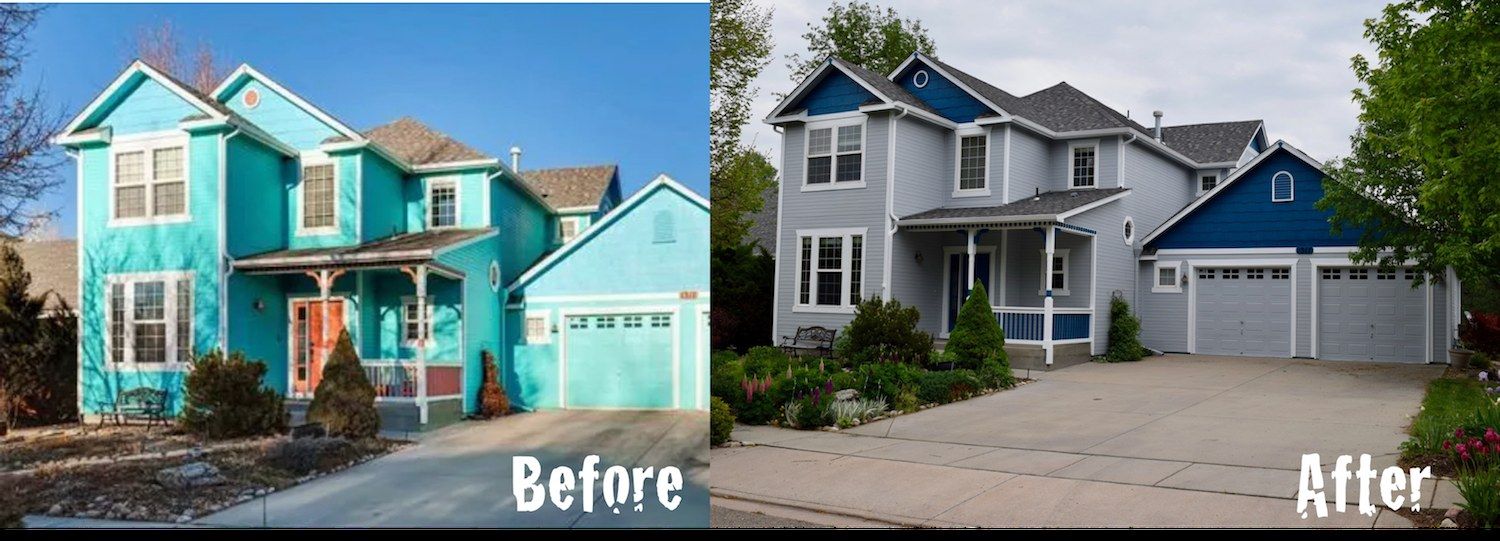
Last week on our Facebook page we shared a two-story that went from a loud tropical teal to a soft modern gray, with deep navy shake gables, crisp white trim, and a navy front door and porch rail pulling it all together. Same house, same bones, completely different curb appeal. Swipe from the before photo to the after and it’s hard to believe it’s the same home.
A swing that big is exciting, and it’s also the kind of project homeowners in Castle Rock, Parker, Highlands Ranch, and across Douglas County tend to put off. It feels like a lot of decisions. It doesn’t have to be. Here’s how we walk folks through a dramatic exterior color change, from “we can’t live with this color anymore” to “we can’t stop looking at it.”
Why bold colors age the way they do
Saturated colors like teal, bright blue, barn red, and sunny yellow are fun on day one. Under Colorado sun, though, they often fade unevenly, so the south and west sides look washed out while the shaded sides still look new. Add a few years of chalking and you get a house that looks tired and loud at the same time.
Taste moves on, too. A color that felt fresh when the house was built can make a home feel dated today, especially if you’re thinking about listing in the next few years. Moving to a calmer, modern body color with a few confident accents is one of the most effective ways to make a house feel current.
Step one: decide what stays
Before you pick a single swatch, look at what isn’t changing:
- The roof. Its undertone (warm brown, cool gray, black) narrows your best body colors fast.
- Stone, brick, and concrete. If they’re staying natural, your new palette has to get along with them.
- Your HOA. Many Douglas County neighborhoods have approved color lists or require a submission. Getting approval before the crew shows up saves a lot of headache.
When these fixed pieces guide the choice, the finished home looks like it was designed that way on purpose.
Step two: build the palette in layers
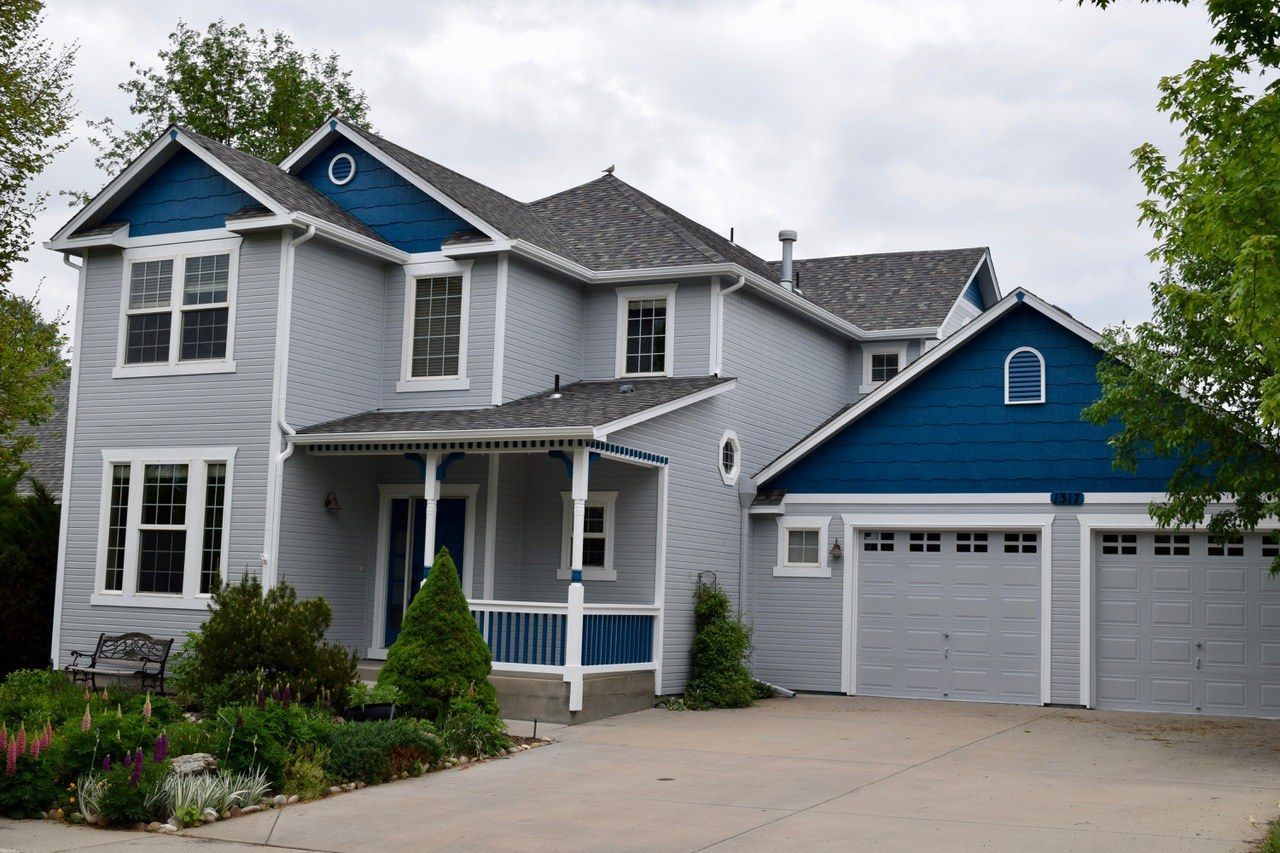
The teal-to-gray house works because each color has a job:
- A calm body color. A soft gray, greige, or warm white covers the most square footage and sets the mood.
- A deeper accent for architecture. On this home, navy on the shake gables gave the roofline shape and depth. Gables, shutters, and board-and-batten sections are great places for a darker tone.
- Crisp trim. Clean white or off-white trim outlines the windows and fascia so the whole house looks sharp from the street.
- One “hello” moment. The front door and porch rail in navy tie the accent color down to eye level, right where guests walk up.
Three or four colors, each with a clear purpose, is usually the sweet spot. More than that, and the house starts to look busy. If you’re still choosing the palette itself, our guide to exterior color combos that work in Castle Rock is a good place to start.
Step three: prep and coverage, where the real work is
This is where a big color change differs from a same-color repaint. Going from a strong, saturated color to a lighter neutral takes more than a single quick coat:
- Thorough cleaning and scraping so the new paint bonds to a sound surface, not loose chalk or failing old paint.
- Caulking and spot repairs on trim, joints, and siding, because a fresh light color shows every gap and crack.
- Primer where it’s needed and enough finish coats to fully hide the old color. Nobody wants teal ghosting through their new gray when the afternoon sun hits it.
- Careful cut lines between body, gables, and trim. With high-contrast palettes like navy and white, sloppy edges are the first thing you notice.
We cover all of this in your written estimate, so you know exactly what’s included before we start.
Step four: mind the Colorado calendar
Exterior paint needs the right weather to go on and cure properly, and every product has its own minimum temperature on the label. We follow it. Fall on the Front Range still gives us plenty of good painting days, and we’re booking exterior jobs through about the end of November, weather permitting. (More on timing in our Colorado fall exterior paint rush post.)
Getting your color change done now means you head into winter with the outside finished, you’re ready for holiday guests, and you’re not staring at a color you don’t love until spring.
How H3 Painting shows up
We’re family-owned and based in Castle Rock, and we treat every exterior color change in Castle Rock and across Douglas County as a service experience, from the first estimate to the final walk-through.
Every job ends with our Blue-Tape Challenge quality guarantee. You walk the finished house with us, put blue tape on anything you don’t love, and we fix it before we call the job done. No arguing. No “that’s close enough.” When you’ve just changed the entire look of your home, that walk-through matters.
Ready to say goodbye to your old color?
If your house has been stuck in a color you’ve outgrown, call (720) 990-3990 or schedule a free estimate. We’ll help you choose a palette that fits your home, your HOA, and our Colorado light, and we’ll tell you honestly what still fits this fall.
H3 Painting
115 Wilcox Street Ste #220, Castle Rock, CO 80104
(720) 990-3990
Serving Castle Rock, Parker, Highlands Ranch, Lone Tree, Douglas County, and the Front Range